
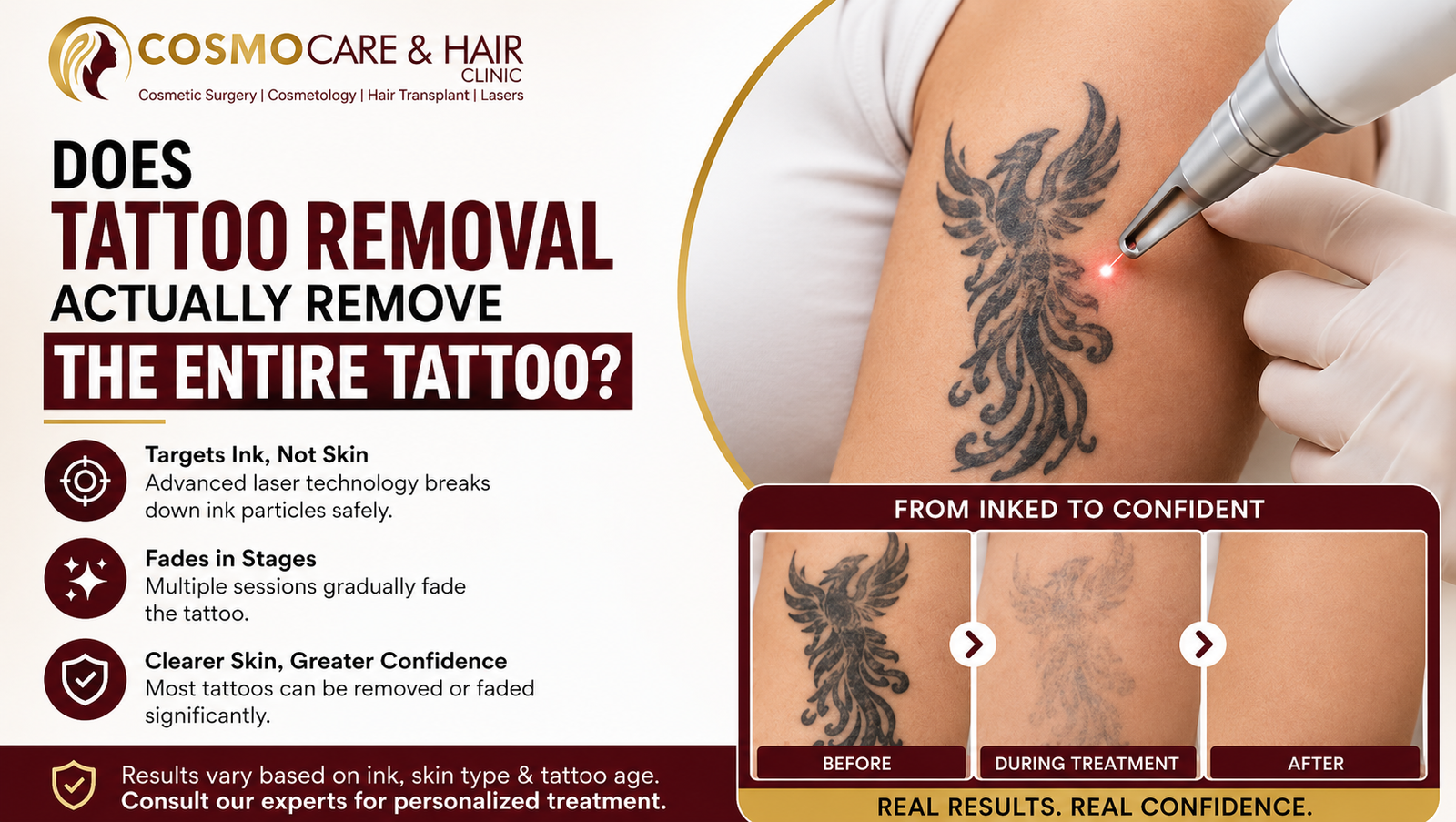
Tattoo removal can significantly fade or, in some cases, completely clear unwanted ink, but it does not always remove the entire tattoo. Modern laser tattoo removal can break tattoo pigments into much smaller particles that the body gradually clears. The final result depends on factors such as ink colour, tattoo depth, skin type, tattoo age, ink composition, and the laser technology used. The FDA also notes that complete tattoo removal without scarring may not always be possible.
Can Laser Tattoo Removal Completely Clear Ink?
Laser tattoo removal is one of the most established methods for reducing unwanted tattoo pigment. During treatment, specially selected laser energy targets the ink beneath the skin and breaks the pigment into smaller particles. The body can then gradually remove these particles over time.
However, complete clearance is not guaranteed for every tattoo. Some tattoos may disappear almost entirely, while others can leave a faint outline, small areas of pigment, or slight changes in skin texture or colour. Research also shows that treatment results can vary considerably between individuals and tattoo types.
Why Some Tattoos Are Harder to Remove?
Several characteristics can make tattoo removal more challenging. The colour of the ink is one of the most important factors. Dark pigments, especially black, often respond well to commonly used laser wavelengths. Certain lighter colours, including yellow, green, and red, can be more difficult to treat and may require a carefully selected laser wavelength.
The depth and amount of pigment also matter. Professional tattoos may contain a greater concentration of ink and can therefore require more treatment sessions than some amateur tattoos. Older tattoos may sometimes respond differently from newer ones, but age alone does not guarantee easy removal.
How Laser Technology Breaks Down Tattoo Pigment?
Laser treatment does not simply burn the tattoo away. Instead, specific laser wavelengths deliver short pulses of energy that target tattoo pigment. Depending on the device and treatment settings, the energy can cause pigment particles to break into smaller fragments.
The body’s natural processes then help clear these fragments gradually. This is one reason tattoo removal usually requires multiple appointments rather than one treatment. Newer picosecond lasers use extremely short pulses and have shown promising results, particularly for certain blue, green, and yellow pigments, although treatment outcomes still vary.
How Many Sessions Are Usually Needed for Removal?
There is no fixed number of sessions that works for every person. Some tattoos may show strong fading after a few treatments, while others need a longer treatment plan. The FDA notes that tattoo removal can take several treatments and gives six to ten treatments as an example, although individual requirements can be higher or lower.
Laser sessions are normally spaced apart so the skin can recover and the body has time to clear fragmented pigment. Treating too aggressively or too frequently does not necessarily produce better results and may increase the chance of unwanted skin reactions.
A professional assessment is therefore important before deciding how many sessions will be needed.
Which Tattoo Colours Are Easiest to Remove?
Black and dark blue tattoos are generally among the easier colours to target with suitable laser wavelengths. Some modern laser systems can also treat multiple colours by using different wavelengths for different pigments.
Green, blue, yellow, red, orange, and other colours can behave differently because each pigment absorbs light differently. Some newer picosecond laser technologies have demonstrated useful results with difficult colours, but this does not mean every multicoloured tattoo will completely disappear.
The specific ink formulation can also affect the response. Two tattoos that look similar may respond differently because their pigments, application depth, or ink concentration are not the same.
What Factors Affect Complete Tattoo Removal?
The possibility of complete removal depends on several factors working together. Tattoo colour, ink density, tattoo depth, size, location, age, and the type of laser available can all influence the final outcome.
Skin type also matters when choosing treatment settings. Laser energy must be carefully balanced between targeting tattoo pigment and protecting the surrounding skin. People with darker skin tones may have a greater risk of temporary or permanent pigment changes if treatment is not appropriately selected and performed.
Your response to previous sessions is another useful indicator. If the tattoo is steadily becoming lighter after each treatment, further sessions may continue to improve the result.
Can Tattoo Removal Leave Marks or Scars?
Even when most of the tattoo pigment is removed, the skin may not always look exactly as it did before the tattoo. Temporary redness, swelling, blistering, crusting, or changes in skin colour can occur after laser treatment. Less commonly, scarring or longer-lasting pigment changes can develop.
This is why tattoo removal should be approached as a medical skin treatment rather than a quick cosmetic procedure. Correct laser selection, suitable treatment settings, proper spacing between sessions, and appropriate aftercare can all contribute to safer results.
The American Academy of Dermatology recommends having laser tattoo removal performed by a dermatologist, particularly because the clinician can also assess moles or other skin changes within or around the tattooed area.
What Results Can You Realistically Expect?
A realistic goal is progressive fading rather than expecting the tattoo to disappear after one appointment. Many tattoos become considerably lighter over a series of treatments, and some may eventually become difficult to see.
Complete clearance is possible in selected cases, but it should not be promised before examining the tattoo. Clinical research has reported both very high clearance in some individual cases and incomplete clearance in others. A systematic review of picosecond laser studies found that 69% to 100% of tattoos in the included human trials achieved more than 70% pigment clearance after one to ten treatments, showing both the potential and variability of laser treatment.
At Cosmo Care & Hair Clinic, tattoo removal can be assessed according to the tattoo’s colour, size, location, skin characteristics, and previous treatment history. A personalized evaluation helps determine whether the goal should be complete clearance or significant fading.
Is Fading Different From Complete Tattoo Removal?
Yes. Tattoo fading means the pigment has been reduced but some visible ink remains. Complete removal means the tattoo pigment has been cleared to a point where no obvious tattoo remains.
This difference is important because photographs taken immediately after a treatment may not represent the final result. The skin needs time to heal and the body needs time to process the fragmented pigment. Results should therefore be evaluated after adequate recovery rather than immediately after a laser session.
For some people, significant fading may be enough if they want to cover the old tattoo with a new design. Others may want the greatest possible clearance and may need additional sessions.
Why Professional Assessment Matters Before Treatment?
A proper consultation helps identify the factors that could affect treatment response. A clinician can examine the tattoo, determine its colours and characteristics, review previous removal attempts, and consider the patient’s skin type before selecting an appropriate treatment approach.
It is also important to avoid unapproved DIY tattoo removal creams or home methods. The FDA states that it has not approved tattoo removal ointments, creams, or do-it-yourself tattoo removal kits, and these products may cause burns, rashes, or scars.
The safest approach is to choose evidence-based treatment under qualified medical supervision and follow the recommended aftercare carefully.
Frequently Asked Questions About Tattoo Removal
1. Can a tattoo be removed 100 percent?
Some tattoos can achieve complete or near-complete clearance, but 100% removal cannot be guaranteed. Tattoo colour, ink depth, density, skin type, and treatment response all influence the final result.
2. How many laser sessions does tattoo removal need?
The number varies from person to person. Some tattoos may need several sessions, while complex or multicoloured tattoos can require considerably more. The FDA notes that six to ten treatments may be needed in some cases.
3. Does black tattoo ink remove more easily?
Black ink generally responds well to commonly used tattoo-removal laser wavelengths. However, the final result still depends on factors such as ink depth, density, tattoo age, and individual skin response.
4. Can tattoo removal damage the skin?
Laser tattoo removal can cause temporary redness, swelling, blistering, crusting, or pigment changes. Scarring is possible but less common. Appropriate laser selection and treatment settings can help reduce risks.
5. Is complete tattoo removal guaranteed?
No. Modern laser technology can provide substantial fading and sometimes complete clearance, but no responsible clinic should guarantee that every tattoo will disappear completely. A consultation is the best way to understand the likely outcome.