
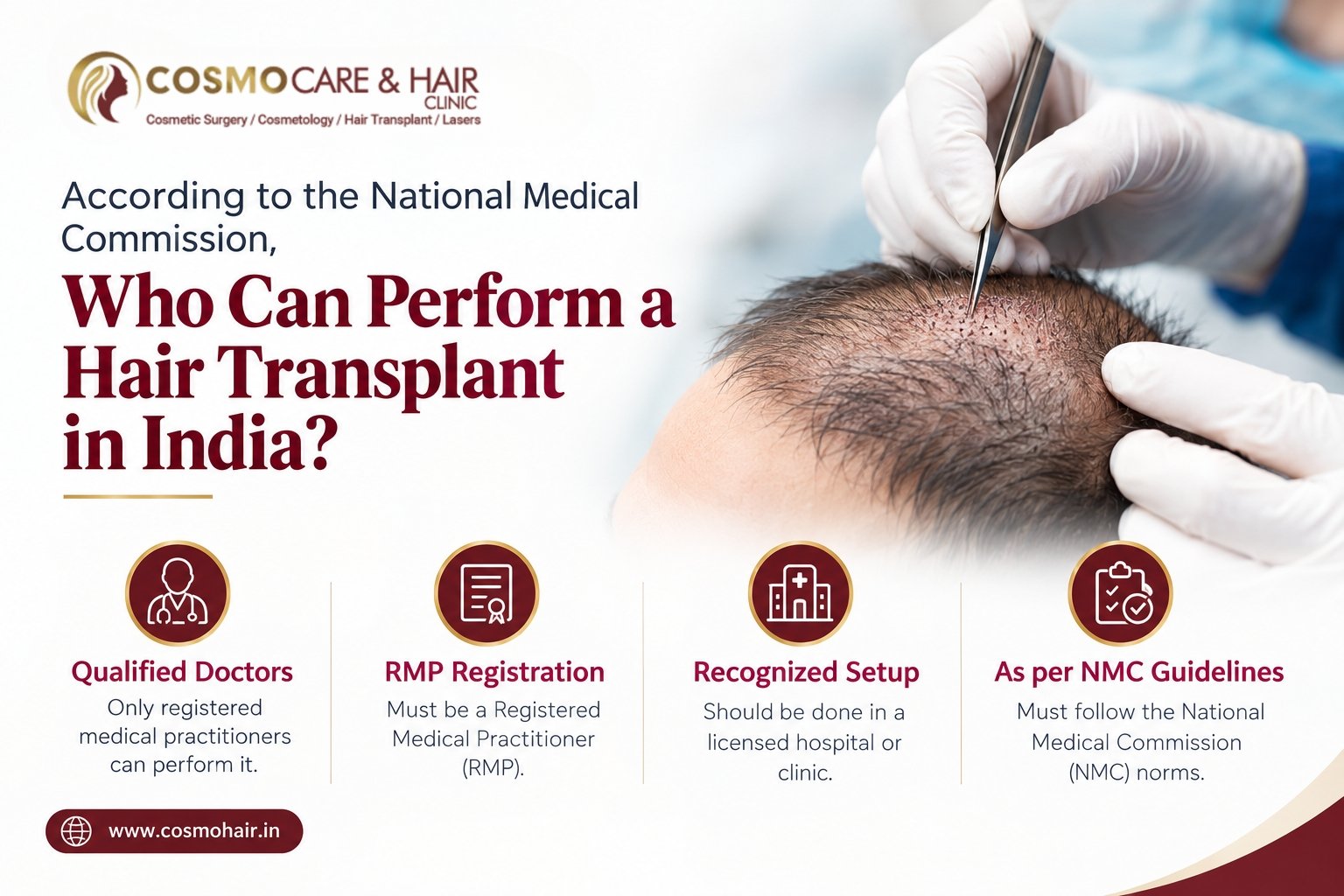
Choosing the right doctor is one of the most important steps when considering a hair transplant in India. Hair transplantation involves surgical procedures such as donor hair harvesting, recipient-site creation, and hairline design. According to the National Medical Commission (NMC), these surgical aspects should be performed by a properly trained and licensed Registered Medical Practitioner (RMP) of Modern Medicine with appropriate education, training, and current competency in hair restoration surgery.
The NMC issued its Guideline on Aesthetic Surgery and Hair Transplant Procedures in September 2022. The guideline specifically addresses who should perform hair restoration surgery and the responsibilities involved before, during, and after the procedure.
For anyone researching hair transplantation, understanding these requirements can help you ask the right questions before selecting a doctor or clinic.
Who Can Perform Hair Transplant Surgery in India?
Hair transplantation is not simply a cosmetic treatment where hair follicles are placed into thinning areas. Surgical steps can involve incisions, tissue removal, graft harvesting, and preparation of recipient sites.
The NMC states that procedures involving skin incision for removing tissue from the scalp or preparing the scalp to receive tissue are considered surgical procedures. These procedures must be performed by a properly trained and licensed RMP practising Modern Medicine.
The doctor should also have appropriate knowledge and clinical skills related to hair physiology, causes of hair loss, scalp anatomy, patient selection, medical treatment of alopecia, surgical procedures, and possible complications.
What the National Medical Council Guidelines Say?
The NMC guideline explains that hair restoration surgery requires specific medical and surgical competency.
The doctor should be able to evaluate whether a patient is suitable for transplantation, identify contraindications, understand different forms of alopecia, plan the procedure, perform the relevant surgical steps, and provide postoperative medical care.
This is important because not every patient experiencing hair loss is automatically a suitable candidate for a transplant.
Which Medical Qualifications Are Relevant?
The NMC guideline states that hair transplantation should preferably be undertaken by doctors who have formal surgical training, specifically mentioning MCh/DNB Plastic Surgery and MD/DNB Dermatology with adequate grooming in dermatological surgical procedures.
The guideline also notes that hair transplantation is included as a core topic within these specialties’ curricula.
Therefore, when selecting a doctor, patients should consider both the recognised medical qualification and the doctor’s specific training and experience in hair restoration surgery.
What Qualifications Should a Hair Transplant Doctor Have?
A suitable hair transplant doctor should have a recognised medical qualification, valid registration to practise, and appropriate training for the surgical procedure being performed.
However, a qualification alone does not tell the complete story. Hair restoration requires an understanding of both medical hair-loss conditions and surgical techniques.
Plastic Surgery Training and Hair Restoration
The NMC specifically identifies MCh/DNB Plastic Surgery as formal surgical training relevant to hair restoration procedures.
Plastic surgery training involves extensive exposure to surgical principles, anatomy, tissue handling, wound management, and reconstructive and aesthetic procedures.
Dermatology Training and Surgical Experience
The NMC also identifies MD/DNB Dermatology with adequate grooming in dermatological surgical procedures as a relevant pathway for hair restoration surgery.
This is particularly relevant because dermatologists deal extensively with scalp and hair disorders, including different forms of alopecia.
The important consideration is whether the doctor has the appropriate training and current competency required for the hair restoration procedure being offered.
Registration and Medical Practice Requirements
Patients should make sure the doctor is a properly trained and licensed Registered Medical Practitioner.
The NMC maintains information about medical registration and also provides details of State Medical Councils. Patients can use the appropriate medical registration resources to verify a doctor’s credentials.
What Parts of Hair Transplant Surgery Require a Doctor?
The NMC guideline specifically identifies several stages of hair restoration surgery that should only be performed by an RMP.
| Hair transplant stage | Medical responsibility |
|---|---|
| Preoperative evaluation | Diagnosis, assessment and candidate selection |
| Treatment planning | Planning the surgical approach and graft requirements |
| Donor hair harvesting | Surgical removal or extraction of donor grafts |
| Hairline design | Designing the hairline according to the patient’s characteristics |
| Recipient-site creation | Preparing the areas where grafts will be placed |
| Medical management | Managing medical issues and possible adverse reactions |
| Postoperative care | Monitoring recovery and providing appropriate medical care |
These stages demonstrate why patients should know exactly who will be performing the procedure rather than choosing a clinic based only on its advertisements or package price.
Hair Loss Diagnosis and Patient Assessment
Before transplantation, the doctor should assess the patient’s hair-loss pattern, scalp condition, donor area, medical history, and suitability for surgery.
The NMC guideline highlights the importance of identifying suitable candidates and recognising contraindications, including active scarring alopecia.
A proper assessment can help determine whether transplantation is appropriate and what type of treatment may be suitable.
Donor Hair Extraction and Graft Harvesting
Donor hair harvesting is a surgical component of hair restoration.
Depending on the technique used, grafts may be harvested using FUE or another recognised method. The NMC specifically includes donor hair harvesting among the aspects of hair restoration surgery that should be performed by an RMP.
Hairline Design and Recipient Site Creation
Hairline design has both medical and aesthetic considerations. The doctor needs to consider factors such as the patient’s existing hair, donor supply, facial characteristics, and anticipated future hair loss.
Creating recipient sites is also an important surgical step because the sites determine where transplanted grafts will be positioned.
Postoperative Care and Complication Management
Medical responsibility continues after the surgery.
The NMC guideline includes postoperative care and management of possible medical issues or adverse reactions within the responsibilities of the RMP.
Patients should therefore ask about the clinic’s follow-up process before booking their procedure.
Can Technicians Perform Hair Transplant Procedures?
Technicians and other trained healthcare staff may assist with certain aspects of a hair transplant, but the NMC guideline distinguishes between assistance and performing surgery.
The guideline states that it is unethical for an RMP to train an individual to perform or assist with surgery when that person is not an accredited health professional licensed to do so.
Patients should therefore ask the clinic to clearly explain which parts of the procedure are performed by the doctor and which tasks are performed by other members of the medical team.
What Technicians Can Do Under Supervision?
A hair transplant may involve a team working under the treating doctor’s supervision. However, this does not mean that a non-medical person can independently perform the surgical components of the procedure.
The NMC’s advisory also states that aesthetic procedures, including hair transplantation, should have appropriate anaesthesia support and requisite resuscitative equipment and drugs.
Why Surgical Steps Require Medical Expertise?
Hair transplantation involves more than moving follicles from one area to another.
A doctor needs to understand the patient’s underlying hair-loss condition, scalp anatomy, donor limitations, surgical risks, possible adverse reactions, and postoperative requirements.
This medical knowledge becomes especially important when unexpected complications or unsuitable patient conditions are identified.
How to Choose the Right Hair Transplant Doctor?
Finding a suitable doctor involves more than searching online for the best hair transplant in India.
Patients should look at qualifications, registration, relevant surgical training, experience, treatment planning, clinic infrastructure, and follow-up care.
Check Medical Registration and Qualifications
Start by verifying the doctor’s medical registration and recognised qualifications.
You can also check the NMC’s available medical registration resources and relevant State Medical Council information.
Ask About Hair Restoration Training
Ask the doctor about specific experience and training in hair restoration procedures.
Questions about FUE, FUT, donor-area management, hairline planning, graft extraction, and postoperative care can help you understand the doctor’s approach.
Understand Who Performs the Surgical Procedure
One of the most useful questions to ask a clinic is:
“Who will perform the surgical parts of my hair transplant?”
Ask specifically about donor harvesting, recipient-site creation, and hairline design.
The NMC guideline identifies these as aspects of hair restoration surgery that should be performed by an RMP.
Review the Clinic’s Safety and Follow-Up Care
The NMC advisory states that aesthetic procedures, including hair transplantation, should have appropriate anaesthesia backup and access to required resuscitation equipment and medicines. It also states that the centre should be registered as a Day Care Centre or Hospital with the relevant local or state authorities and have an appropriately equipped postoperative recovery area.
These are important questions to consider before undergoing treatment.
What Should You Ask Before a Hair Transplant?
A consultation should give you a clear understanding of your hair-loss condition and the proposed treatment.
Questions About Your Hair Loss
Ask:
- What is causing my hair loss?
- Is my hair loss stable?
- Am I a suitable candidate for transplantation?
- How much donor hair do I have?
- Could my hair loss progress after transplantation?
Questions About the Surgical Procedure
You can also ask:
- Which technique is recommended for me?
- Who will perform the donor harvesting?
- Who will create the recipient sites?
- Who will design my hairline?
- What are the potential risks and complications?
- What type of anaesthesia or medical support will be available?
Questions About Recovery and Results
Before treatment, understand:
- Expected recovery time
- Postoperative instructions
- Follow-up schedule
- Possible temporary shedding
- Expected timeline for visible growth
- What happens if a complication occurs
Having these conversations can help you make a more informed treatment decision.
Choosing a Hair Transplant Clinic in India
The quality of a hair transplant depends on several factors, including appropriate patient selection, surgical planning, technique, medical expertise, and postoperative care.
A clinic should provide transparent information about the doctor performing the procedure and the medical team involved.
Patients should also be cautious of exaggerated claims or guarantees. The NMC advisory specifically states that false or exaggerated advertising claims should not be used for aesthetic procedures.
Why Personalised Hair Loss Assessment Matters?
Every patient’s hair loss is different.
Age, pattern of hair loss, donor density, scalp condition, existing hair, and future progression can all influence the treatment plan.
A personalised assessment allows the doctor to determine whether transplantation is appropriate and how the procedure should be planned.
The Role of Experienced Hair Restoration Doctors
An experienced doctor can assess the medical aspects of hair loss while also considering the aesthetic goals of the patient.
The aim should be to create a treatment plan that considers both the current condition of the scalp and the long-term availability of donor hair.
Hair Transplant Treatment at Cosmo Care & Hair Clinic
At Cosmo Care & Hair Clinic, Dr. Rahul Goyal focuses on understanding each patient’s concerns and treatment goals before recommending a suitable approach.
The consultation process is designed around individual assessment rather than treating every patient with the same procedure. Dr. Rahul Goyal’s experience in cosmetic and hair transplant procedures allows patients to discuss their concerns and understand the available treatment options.
The clinic also focuses on patient care from the initial consultation through follow-up, with attention to treatment planning and individual requirements.
For patients considering a hair transplant in Chandigarh or elsewhere in India, discussing your case directly with a qualified doctor can help you understand whether transplantation is appropriate for you.
Frequently Asked Questions About Hair Transplant Doctors
1. Who can perform a hair transplant in India?
According to the NMC’s 2022 guideline, surgical hair restoration procedures should be performed by a properly trained and licensed Registered Medical Practitioner of Modern Medicine with appropriate education, training, and current competency in hair restoration surgery.
2. Does the NMC mention specific qualifications for hair transplant surgery?
Yes. The NMC guideline says hair restoration surgery should preferably be undertaken by doctors with formal surgical training such as MCh/DNB Plastic Surgery or MD/DNB Dermatology with adequate grooming in dermatological surgical procedures.
3. Can a technician perform a hair transplant independently?
The NMC guideline identifies the surgical components of hair restoration as responsibilities of an RMP. It also states that it is unethical for an RMP to train an unlicensed individual to perform or assist with surgery.
4. What should I check before choosing a hair transplant doctor?
Check the doctor’s medical registration, recognised qualifications, relevant hair restoration training, surgical experience, clinic facilities, who performs the surgical steps, and the postoperative follow-up process.
5. How can I verify a doctor’s medical registration?
You can use the medical registration resources provided by the NMC and relevant State Medical Councils to verify registration information.
Consult a Qualified Doctor for Hair Restoration
The NMC’s guidance makes it clear that hair transplantation involving surgical procedures should be performed by an appropriately trained and licensed medical practitioner. The doctor should have suitable knowledge and competency in hair restoration, including patient evaluation, surgical planning, graft harvesting, recipient-site creation, and postoperative care.
If you are considering a hair transplant in India, don’t choose a clinic based only on price, advertisements, or promises of guaranteed results. Check the doctor’s qualifications, registration, surgical experience, treatment approach, and the level of medical supervision provided during the procedure.
At Cosmo Care & Hair Clinic, you can discuss your hair-loss concerns and treatment goals with Dr. Rahul Goyal and understand whether hair transplantation is suitable for your case.
Contact Cosmo Care & Hair Clinic today to schedule a consultation and take the first step toward a personalised hair restoration plan.