
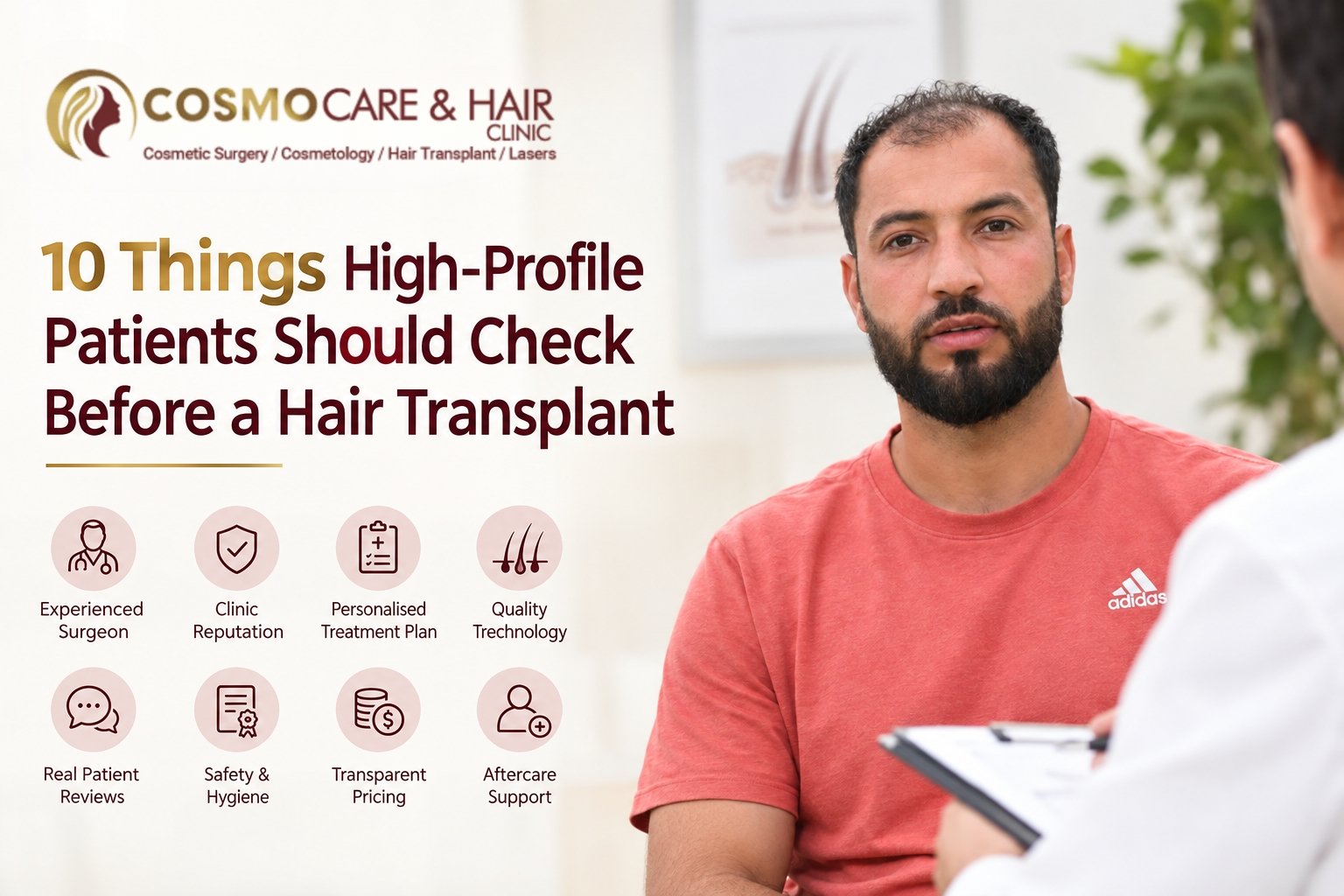
Hair loss can affect confidence, personal appearance, and professional life. For public figures, business leaders, executives, and other high-profile individuals, choosing a Hair Transplant procedure may require additional planning around privacy, recovery time, and natural-looking results. Before making a decision, it is important to understand the treatment process, evaluate the surgeon’s experience, and consider how the procedure may fit into your daily schedule.
A hair transplant is a surgical procedure that moves hair follicles from a donor area, usually the back or sides of the scalp, to areas affected by hair loss. Although modern techniques can produce natural-looking results, outcomes depend on several factors, including hair characteristics, the extent of hair loss, the availability of donor hair, and the expertise of the medical team.
For high-profile patients, the decision involves more than selecting a clinic or comparing prices. Here are 10 important things to check before scheduling a procedure.
1. Check the Surgeon’s Experience and Credentials
The surgeon’s qualifications and experience should be among your first considerations. Hair transplantation requires careful planning, an understanding of scalp anatomy, and technical precision to achieve an appropriate hairline and natural follicle placement.
Before choosing a surgeon, consider the following:
- Medical qualifications: Confirm the surgeon’s relevant medical training and credentials.
- Hair transplant experience: Ask about experience treating patients with hair loss patterns similar to yours.
- Treatment planning: Understand who will assess your scalp, design the hairline, and oversee the procedure.
- Medical supervision: Clarify which steps the surgeon performs and which tasks are handled by trained team members.
Do not rely solely on social media popularity, celebrity associations, or promotional claims. A qualified medical professional should explain the procedure, potential limitations, and possible complications before you commit.
2. Understand the Clinic’s Privacy Policies
Privacy can be especially important for high-profile patients who want to keep their treatment confidential. Before booking a consultation, ask how the clinic protects personal information and manages patient records.
Important questions include:
- Who can access your medical records and photographs?
- Are before-and-after photographs shared only with your explicit permission?
- How are consultation details and treatment information stored?
- Can appointments be arranged to reduce unnecessary exposure in waiting areas?
- What policies apply to staff discussions about patients?
A clinic should explain its confidentiality procedures clearly and comply with applicable data protection and medical confidentiality requirements.
However, privacy should not mean avoiding essential medical documentation. Accurate records, informed consent, and appropriate follow-up care remain necessary for patient safety.
3. Choose the Right Hair Transplant Technique
Different hair transplant techniques suit different patients. Your choice should depend on your scalp condition, donor hair availability, hair loss pattern, expectations, and the surgeon’s assessment.
Two commonly discussed techniques are FUE and FUT.
Follicular Unit Extraction (FUE)
FUE involves extracting individual follicular units from the donor area and placing them into areas with thinning or missing hair. It generally leaves small, scattered scars rather than one linear scar. Hair length, healing time, and visible signs of the procedure vary between patients.
Follicular Unit Transplantation (FUT)
FUT involves removing a strip of scalp from the donor area and dissecting it into follicular units for transplantation. It typically leaves a linear scar, which may be more noticeable with very short hairstyles.
| Factor | FUE | FUT |
|---|---|---|
| Extraction method | Individual follicular units | A strip of scalp |
| Scarring | Multiple small scars | Usually one linear scar |
| Hairstyle considerations | May suit shorter hairstyles, depending on scarring | Requires consideration of the linear scar |
| Donor area | Individual extraction sites | Incision requiring closure |
| Suitability | Depends on donor characteristics and goals | Depends on donor characteristics and goals |
Neither method is universally better. Discuss the advantages, limitations, risks, and expected recovery with your surgeon before selecting a technique.
4. Prioritize Natural-Looking Hairline Design
A natural-looking hairline is one of the most important considerations for patients who regularly appear in public, attend professional events, or have their photographs taken.
An overly straight, low, or dense hairline may look unnatural, particularly as surrounding hair continues to thin with age. A well-planned hairline should complement facial proportions, age, existing hair density, and likely future hair loss.
During consultation, discuss:
- The appropriate height and shape of your hairline.
- The direction and angle of transplanted follicles.
- The density that can realistically be achieved.
- How the transplanted area may look under different lighting conditions.
- Whether additional treatment could be needed as hair loss progresses.
Ask the surgeon to explain the proposed design before the procedure. The goal should be a result that suits your appearance rather than simply maximising the number of transplanted grafts.
5. Evaluate Donor Hair and Long-Term Planning
Donor hair is a limited resource. The follicles available at the back and sides of the scalp must be assessed carefully before deciding how many grafts to transplant.
A patient with extensive hair loss may not have enough suitable donor hair to restore every affected area to its original density. The surgeon should evaluate donor density, hair calibre, scalp condition, and the stability of hair loss.
Long-term planning is particularly important for younger patients and those with progressive hair thinning.
Ask your surgeon:
- How many grafts may be appropriate for the current treatment?
- Will enough donor hair remain for future procedures if needed?
- Could untreated hair continue to thin around the transplanted area?
- Are non-surgical treatments appropriate for your condition?
- What results are realistic over the next several years?
A responsible treatment plan considers both present concerns and future hair loss rather than focusing only on immediate cosmetic improvement.
6. Plan the Procedure Around Your Schedule
High-profile patients may have demanding work commitments, public appearances, travel plans, or important events. Although a hair transplant is commonly performed as an outpatient procedure, recovery still requires time and attention.
Before booking, discuss your schedule with the clinic and establish a realistic recovery plan.
Immediately after treatment, the scalp may show redness, swelling, small scabs, or tenderness. Some patients also experience temporary swelling around the forehead. These effects vary depending on the procedure and individual healing.
Consider the following when planning your appointment:
- Allow time for the initial healing period.
- Avoid scheduling the procedure immediately before a major public appearance.
- Follow instructions regarding exercise, sun exposure, washing, and scalp protection.
- Confirm when it is safe to resume work, travel, and other normal activities.
- Arrange follow-up appointments before committing to a demanding schedule.
There is no single recovery timeline that suits everyone. Your surgeon should provide personalised guidance based on the technique used and your healing progress.
7. Check the Clinic’s Safety and Hygiene Standards
Hair transplantation is a surgical procedure, so infection prevention, appropriate equipment, and medical supervision matter as much as cosmetic results.
Before proceeding, ask about the clinic’s hygiene protocols, emergency arrangements, and preoperative assessment process.
A responsible clinic should explain how it evaluates your medical history, current medications, allergies, scalp health, and any conditions that could affect healing. You should also receive clear instructions about eating, drinking, medication use, and preparation for the procedure, where applicable.
Check that the facility follows appropriate sterilisation procedures and that the medical team can recognise and manage complications.
Do not hesitate to ask about possible risks, including infection, bleeding, scarring, temporary numbness, poor graft growth, and an unnatural appearance. Understanding these risks helps you make an informed decision.
8. Review Before-and-After Results Carefully
Before-and-after photographs can help you understand a surgeon’s work, but they should be assessed critically. Attractive promotional images alone cannot guarantee that you will achieve a similar result.
Look for examples involving patients with comparable hair loss patterns, hair characteristics, and treatment goals.
When reviewing photographs, consider:
- Whether the images show consistent lighting and angles.
- Whether the hairline looks natural rather than excessively straight or dense.
- How the donor area appears after healing.
- Whether results are shown after sufficient time for hair growth.
- Whether the clinic explains the number of grafts and technique used.
Hair transplant results develop gradually. Transplanted hair may shed temporarily before new growth begins, and visible improvement generally takes several months. Many patients assess more mature results around 9–12 months, although the timeline varies and some areas may take longer.
Ask the surgeon to explain what the photographs demonstrate and how your own characteristics could affect the outcome.
9. Understand the Full Cost and Follow-Up Care
The cost of a hair transplant can vary depending on the technique, number of grafts, medical team, facility, and complexity of the case. Choosing a clinic based only on the lowest quoted price can overlook important aspects of safety and aftercare.
Request a clear breakdown of the proposed treatment cost before confirming your appointment.
| Cost consideration | What to clarify |
|---|---|
| Consultation | Whether the assessment fee is separate |
| Procedure | What the quoted price includes |
| Medication | Whether prescribed medicines are included |
| Follow-up visits | How many appointments are covered |
| Additional care | Whether extra consultations or treatments cost more |
| Future treatment | Whether further procedures may be needed |
You should also understand what happens if healing is slower than expected or the results differ from the initial plan.
A hair transplant is not a one-time guarantee against future hair loss. Your surgeon may recommend ongoing medical management or periodic assessments to help maintain the health of your existing hair.
10. Set Realistic Expectations Before Treatment
Even with careful planning and an experienced surgeon, hair transplantation has limitations. The procedure redistributes existing hair follicles; it does not create an unlimited supply of new follicles.
The final appearance depends on donor hair quality, scalp characteristics, graft survival, healing, and the progression of hair loss. Some patients achieve noticeable coverage, while others may require a more conservative approach because of limited donor supply.
Before proceeding, discuss your priorities openly. You may want to improve the frontal hairline, add density to a thinning crown, or create better overall coverage. Your surgeon should explain which goals are achievable and which may not be realistic.
Ask for a clear discussion of expected results, potential complications, and alternative treatments. You should feel comfortable asking questions and taking time to make your decision.
At Cosmo Care & Hair Clinic, Dr. Rahul Goyal focuses on patient-centred consultation, careful treatment planning, and guidance tailored to individual concerns. The aim is to help patients understand their options and make informed decisions based on their needs.
Why Careful Planning Matters Before a Hair Transplant?
Choosing a hair transplant clinic involves much more than comparing techniques or looking at photographs. High-profile patients should pay particular attention to medical qualifications, confidentiality, natural-looking results, recovery planning, safety standards, and long-term hair management.
A detailed consultation can help identify the most suitable approach and clarify what to expect before, during, and after treatment. Taking time to assess these factors can help you avoid unrealistic promises and make a decision that supports your health and appearance.
At Cosmo Care & Hair Clinic, patients can discuss their concerns with Dr. Rahul Goyal and receive guidance based on their individual hair loss patterns, expectations, and treatment requirements.
Ready to explore your hair restoration options? Schedule a consultation with Cosmo Care & Hair Clinic to discuss your concerns, understand the available treatments, and develop a personalised plan with appropriate medical guidance.
Frequently Asked Questions
1. What should high-profile patients check before a hair transplant?
They should assess the surgeon’s qualifications, clinic privacy policies, surgical techniques, safety standards, expected results, recovery requirements, and follow-up care. A thorough consultation helps establish whether the procedure is appropriate for their needs.
2. How long does it take to recover from a hair transplant?
Initial healing usually takes around 7–14 days, although recovery varies by patient and technique. Redness and scabbing may take time to settle, and patients should follow their surgeon’s instructions before resuming exercise or other activities.
3. Will a hair transplant look natural in photographs?
A natural appearance depends on hairline design, follicle placement, hair characteristics, graft distribution, and the surgeon’s technique. No result can be guaranteed, but careful planning can help create a result that complements the patient’s facial features.
4. Is FUE better than FUT for high-profile patients?
Neither technique is best for everyone. FUE generally produces multiple small scars, while FUT usually leaves a linear scar. The appropriate method depends on donor hair, hairstyle preferences, scalp characteristics, and treatment goals.
5. How long does it take to see hair transplant results?
Transplanted hair often sheds temporarily in the first few weeks before new growth begins. Noticeable growth commonly develops over several months, with many patients assessing fuller results around 9–12 months. Individual timelines vary, and some patients may need longer.