
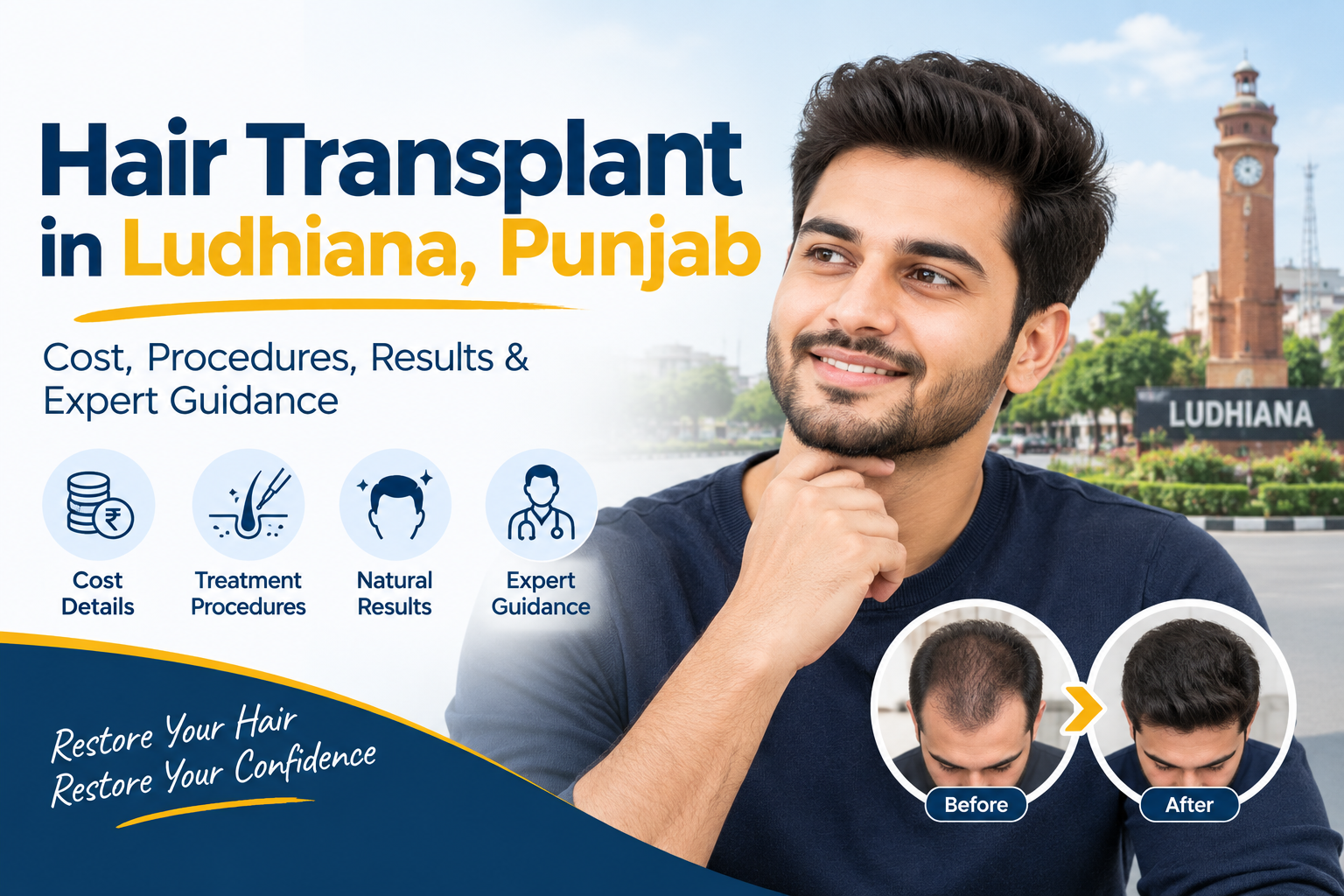
Hair Transplant in Ludhiana, Punjab – Cost, Procedures, Results & Expert Guidance
Hair loss can be frustrating, especially when thinning hair or a receding hairline begins affecting your appearance. Fortunately, modern hair restoration procedures offer surgical treatment options for suitable patients experiencing permanent hair loss.
If you are considering a hair transplant in Ludhiana, Punjab, understanding the available techniques, costs, recovery and expected results can help you make an informed decision.
A hair transplant involves moving healthy hair follicles from a donor area, usually the back or sides of the scalp, to areas affected by baldness. The procedure requires careful assessment, accurate graft placement and long-term planning.
At Cosmo Care & Hair Clinic, patients exploring hair restoration can learn about individual treatment options and seek personalised consultation with Dr. Rahul Goyal in Chandigarh.
This guide explains the important factors patients from Ludhiana and other parts of Punjab should understand before choosing hair transplant surgery.
Quick Answer: What Is a Hair Transplant in Ludhiana, Punjab?
A hair transplant is a surgical procedure that transfers healthy hair follicles into thinning or bald areas of the scalp. FUE and FUT are established methods, while DHI describes an implantation approach. The cost varies according to the graft count, procedure and individual requirements. A qualified doctor should assess the cause of hair loss before recommending surgery.
Hair Transplant Treatment in Ludhiana: Understanding the Causes of Hair Loss
Before choosing a hair transplant treatment, it is important to identify why hair loss is occurring.
Androgenetic alopecia, commonly known as male or female pattern hair loss, is a frequent reason patients consider surgical restoration.
In men, it often causes hairline recession, temple thinning or crown baldness. Women may experience widening of the central parting or a reduction in overall hair density.
However, other conditions can also cause hair loss, including:
- Nutritional deficiencies
- Thyroid disorders
- Certain medications
- Alopecia areata
- Scalp inflammation or infection
- Stress-related temporary shedding
- Hormonal changes
Not every condition requires surgery. Some patients may benefit more from medical treatment or investigation of the underlying cause.
Hair transplantation generally works best when the patient has a suitable pattern of hair loss and adequate healthy donor follicles.
Types of Hair Transplant in Ludhiana, Punjab
Different hair transplantation methods are used depending on the patient’s donor area, hair loss pattern, treatment goals and medical suitability.
FUE Hair Transplant in Ludhiana
Follicular Unit Extraction (FUE) involves removing individual follicular units from the donor region and transplanting them into thinning areas.
This technique does not create the long linear scar associated with strip harvesting. However, small extraction scars can still develop.
FUE may be suitable for selected patients with sufficient donor density and realistic coverage expectations.
Its potential advantages include individual graft extraction, flexibility in donor selection and the absence of a long strip-harvesting scar.
FUT Hair Transplant in Ludhiana
Follicular Unit Transplantation (FUT), also known as the strip technique, involves removing a narrow strip of hair-bearing scalp.
The strip is divided into follicular grafts, which are implanted into the recipient area.
FUT may be appropriate for certain patients based on the surgeon’s assessment. However, it leaves a linear donor scar, and patients should consider its implications before choosing the procedure.
DHI Hair Transplant in Ludhiana
Direct Hair Implantation (DHI) usually involves placing extracted follicles using a specialised implantation instrument.
DHI is frequently presented as a separate treatment method, although follicle extraction may still use FUE.
The technique alone does not determine the outcome. Hairline planning, graft handling, implantation direction and donor preservation remain essential.
FUE vs FUT vs DHI: Which Hair Transplant Technique Is Better?
| Feature | FUE | FUT | DHI |
| Main approach | Individual graft extraction | Strip harvesting | Implanter-assisted placement |
| Scarring | Small extraction scars | Linear donor scar | Depends on extraction method |
| Donor management | Individual follicle harvesting | Strip-based harvesting | Depends on harvesting method |
| Suitability | Patient-specific | Patient-specific | Patient-specific |
There is no universally superior technique. The most appropriate method depends on individual medical and surgical considerations.
Hair Transplant Cost in Ludhiana, Punjab
Hair transplant cost in Ludhiana is among the most common concerns for people considering treatment.
The final cost depends on the number of grafts required, the selected technique, the doctor’s expertise and the complexity of the procedure.
Estimated Hair Transplant Price in Ludhiana
The following table uses an illustrative FUE planning range of ₹25–₹55 per graft.
| Grafts Required | Estimated Cost |
| 1,000 grafts | ₹25,000–₹55,000 |
| 1,500 grafts | ₹37,500–₹82,500 |
| 2,000 grafts | ₹50,000–₹1,10,000 |
| 2,500 grafts | ₹62,500–₹1,37,500 |
| 3,000 grafts | ₹75,000–₹1,65,000 |
| 3,500 grafts | ₹87,500–₹1,92,500 |
These figures are illustrative calculations, not confirmed prices from a specific clinic. Actual quotations may differ and should be confirmed during consultation.
What Factors Affect Hair Transplant Cost in Punjab?
Several factors influence the total treatment cost.
Number of grafts: Larger areas of hair loss may require more grafts, increasing the overall cost.
Technique: Extraction and implantation methods may have different pricing structures.
Doctor’s expertise: Qualifications, relevant experience and the degree of surgeon involvement are important considerations.
Hair loss severity: Advanced thinning can require more complex planning.
Donor hair availability: Limited donor density may restrict the achievable coverage.
Aftercare: Medication, follow-up consultations and additional services may affect the final quotation.
Patients should request a complete cost breakdown rather than relying only on an advertised price per graft.
How Many Grafts Are Needed for Hair Transplant Surgery?
A hair graft is a follicular unit that may contain one or more hair strands. Therefore, 2,000 grafts does not necessarily mean 2,000 individual hairs.
The graft requirement depends on the size of the affected area, donor density, hair thickness and desired cosmetic coverage.
Someone with a receding hairline may need fewer grafts than a patient experiencing extensive frontal and crown thinning.
For an initial assessment, patients can try the Hair Transplant Graft Calculator provided by Cosmo Care & Hair Clinic.
The calculator gives an indicative estimate based on selected hair loss areas and hair characteristics. The final graft requirement must be determined through a medical examination.
Who Is a Suitable Candidate for Hair Transplant Surgery in Punjab?
Hair transplantation may be considered for people with established pattern hair loss and sufficient healthy donor follicles.
Suitable candidates may include:
- Men experiencing stable pattern baldness
- Selected women with suitable donor hair
- Individuals with receding hairlines
- Patients with crown thinning
- People with stable hair loss involving certain scars
- Adults with realistic treatment expectations
However, surgery is not suitable for everyone.
Younger patients should also discuss the possibility of future hair loss before committing to a permanent hairline design.
Who Can Perform Hair Transplant Surgery in India? Understanding NMC Guidelines
Patient safety should be a priority when selecting a hair transplant surgeon in Ludhiana or elsewhere in Punjab.
Hair transplantation involves surgical activities such as donor harvesting and preparing the scalp for follicular implantation.
The National Medical Commission’s September 2022 guideline explains the importance of appropriate medical registration, surgical training and competency for practitioners performing hair restoration procedures.
Patients should verify the treating doctor’s qualifications, medical registration and experience with the proposed procedure.
For additional information, read the detailed guide on who can perform a hair transplant in India according to National Medical Commission guidelines.
A transparent consultation should also explain who will perform the surgical steps and how potential complications are managed.

Step-by-Step Hair Transplant Procedure
Although the exact process varies according to the technique, hair transplant surgery usually involves the following stages.
01
Hair and Scalp Examination
The doctor assesses the pattern of hair loss, medical history and donor hair availability.
02
Hairline Design and Treatment Planning
The surgeon plans graft placement according to facial proportions, natural hair direction and expected future hair loss.
03
Donor Area Preparation
The donor region is prepared, and local anaesthesia is administered before extraction.
04
Hair Follicle Extraction
Follicular units are collected using the selected method. Careful handling helps preserve graft viability.
05
Recipient Site Preparation
The surgeon plans where the follicles will be placed, considering density, angle and natural hair growth direction.
06
Graft Implantation
The extracted grafts are implanted into the selected areas of the scalp.
07
Postoperative Instructions
Patients receive guidance about scalp cleaning, medication, physical activity and follow-up appointments.
Hair Transplant Recovery Time: When Can You Expect Results?
Understanding the recovery process is important because transplanted hair does not grow to its final appearance immediately.
Androgenetic alopecia, commonly known as male or female pattern hair loss, is a frequent reason patients consider surgical restoration.
First 7–14 Days
Mild swelling, redness, tenderness and crusting may occur around the treatment area.
Patients should follow the surgeon’s instructions regarding scalp washing, sleeping positions and physical activity.
Weeks 2–8
Some transplanted hair shafts may shed. This is commonly observed during the early recovery period.
Months 3–4
New hair growth may gradually become visible. Early growth can appear fine or uneven.
Months 6–9
Many patients begin noticing visible improvements in coverage and density.
Months 10–18
Additional hair growth and maturation may continue. The final cosmetic appearance varies between individuals.
Individual recovery patterns differ. Patients should consult their surgeon if they experience unusual pain, increasing swelling, fever or signs of infection.
Are Hair Transplant Results Permanent?
Hair transplanted from suitable donor areas can continue growing for many years.
However, no procedure can guarantee permanent density in every individual.
Existing non-transplanted hair may continue thinning as pattern hair loss progresses. Consequently, long-term treatment planning is important.
A doctor may recommend medical hair loss management to preserve existing hair where appropriate.
The durability and appearance of results depend on donor hair quality, surgical planning, healing and progression of hair loss.
Hair Transplant Before and After Results: What Should Patients Check?
Before-and-after photographs can help patients understand how hair restoration may change the appearance of a receding hairline or thinning crown.
However, photographs should be examined carefully.
Look for consistent lighting, similar camera angles, realistic density and clearly stated treatment timelines.
Remember that previous patient photographs do not guarantee the same result for everyone.
Natural-looking outcomes depend on several factors, including individual hair characteristics, donor supply, hairline planning and healing.
Estimated Hair Transplant Price in Ludhiana
Hair Transplant for Men
The following table uses an illustrative FUE planning range of ₹25–₹55 per graft.
A treatment plan may involve restoring the frontal hairline, improving crown coverage or addressing selected areas of thinning.
Future hair loss must be considered so that the restored hairline remains proportionate over time.
Hair Transplant for Women
Women may develop diffuse thinning or widening of the central hair parting.
Selected women can benefit from transplantation when they have adequate stable donor hair and a suitable pattern of loss.
However, hair thinning in women can have several causes. Medical evaluation is important before deciding whether surgery is appropriate.
Is Hair Transplant Surgery Safe? Possible Risks and Side Effects
Hair transplant surgery is generally considered safe when appropriately planned and performed by qualified medical professionals, but complications remain possible.
Potential risks include:
- Infection
- Bleeding
- Temporary swelling and discomfort
- Scarring
- Altered scalp sensation
- Poor graft growth
- Uneven hair density
- An unnatural hairline
- Continued loss of surrounding natural hair
Patients should discuss medical conditions, medications and previous surgical history before treatment.
Selecting a qualified medical team and following postoperative instructions can help reduce avoidable risks, although complications cannot always be prevented.
How to Choose a Hair Transplant Clinic for Patients from Ludhiana, Punjab
People searching for the best hair transplant clinic in Ludhiana, Punjab should evaluate medical suitability and patient care rather than depending only on promotional claims.
Important considerations include the treating doctor’s qualifications, surgical experience, donor hair assessment, procedure planning and follow-up support.
Patients should also ask whether the clinic explains potential risks, treatment alternatives and realistic graft requirements.
For those willing to travel from Ludhiana to Chandigarh, information about the clinic facilities and patient care at Cosmo Care & Hair Clinic can help them understand the treatment setting before arranging a visit.
The clinic is located in Sector 32, Chandigarh. Patients should confirm appointment availability and postoperative follow-up requirements before travelling.
Hair Transplant Consultation for Patients from Ludhiana and Punjab
Choosing hair transplant surgery should begin with accurate information about your hair loss condition and available treatment options.
Dr. Rahul Goyal at Cosmo Care & Hair Clinic in Chandigarh provides hair restoration consultations for patients considering surgical treatment.
Patients travelling from Ludhiana or other cities in Punjab can enquire about donor assessment, graft requirements, suitable techniques, recovery expectations and individual treatment costs.
Book a Hair Transplant Consultation
Clinic Address: SCO 273, Sector 32D, Chandigarh, Punjab region – 160030
An individual assessment is necessary to determine whether transplantation is appropriate and what results may realistically be achieved.
Frequently Asked Questions About Hair Transplant in Ludhiana, Punjab
1. What is the average hair transplant cost in Ludhiana?
The cost depends on the graft count, technique and individual treatment plan. Patients should request a quotation after donor area examination rather than relying exclusively on advertised packages.
2. Which is the best hair transplant clinic in Ludhiana, Punjab?
The best choice depends on your medical needs. Look for qualified doctors, transparent surgical planning, genuine results, patient safety practices and appropriate postoperative care.
3. How much does a 2,000-graft hair transplant cost in Punjab?
Using an illustrative range of ₹25–₹55 per graft, 2,000 grafts would cost approximately ₹50,000–₹1,10,000 before possible additional charges. Actual prices vary.
4. Is FUE hair transplant better than FUT?
Neither technique is better for every patient. FUE avoids a long linear strip scar, while FUT may offer advantages in selected circumstances. A qualified surgeon should recommend a method based on individual needs.
5. Is hair transplant surgery painful?
Local anaesthesia is typically used during surgery. Patients may experience discomfort during anaesthetic administration and temporary soreness afterward.
6. How many days are required for hair transplant recovery?
Initial recovery commonly takes around one to two weeks. Visible hair growth takes several months, and the final result may require a year or longer.
7. Can women undergo a hair transplant in Punjab?
Yes, selected women may be suitable candidates. The doctor must assess the cause of thinning, donor density and potential benefits before recommending surgery.
8. Are hair transplant results permanent?
Transplanted follicles can provide long-lasting growth, but existing hair may continue thinning. Results depend on surgical planning and individual hair loss progression.
9. How many grafts are required for a receding hairline?
The graft count depends on the width of the receded area, desired density, existing hair and available donor follicles. A scalp examination is needed for an accurate estimate.
10. Is DHI better than FUE hair transplant?
DHI and FUE describe different aspects of the hair transplant process. DHI generally refers to an implantation approach, whereas FUE describes follicle extraction. The overall surgical plan is more important than the marketing name of a technique.
11. Can transplanted hair fall out after surgery?
Temporary shedding of transplanted hair shafts can occur during the early recovery period. New growth may emerge from surviving follicles in subsequent months.
12. What are the risks of hair transplant surgery?
Potential complications include infection, bleeding, swelling, scarring, altered sensation and unsatisfactory hair growth. Patients should discuss these risks before treatment.
13. Can a hair transplant treat complete baldness?
Patients with extensive baldness may have insufficient donor follicles to achieve complete coverage. Suitability depends on available donor hair and realistic treatment goals.
14. Can patients from Ludhiana travel to Chandigarh for hair transplant treatment?
Yes. Patients may consider clinics outside their home city, provided they plan for consultation, surgery, safe return travel and postoperative follow-up.
15. How can I choose a qualified hair transplant surgeon in Punjab?
Check medical registration, relevant qualifications, surgical experience, the doctor’s role in the procedure and the clinic’s approach to patient safety and postoperative care.