
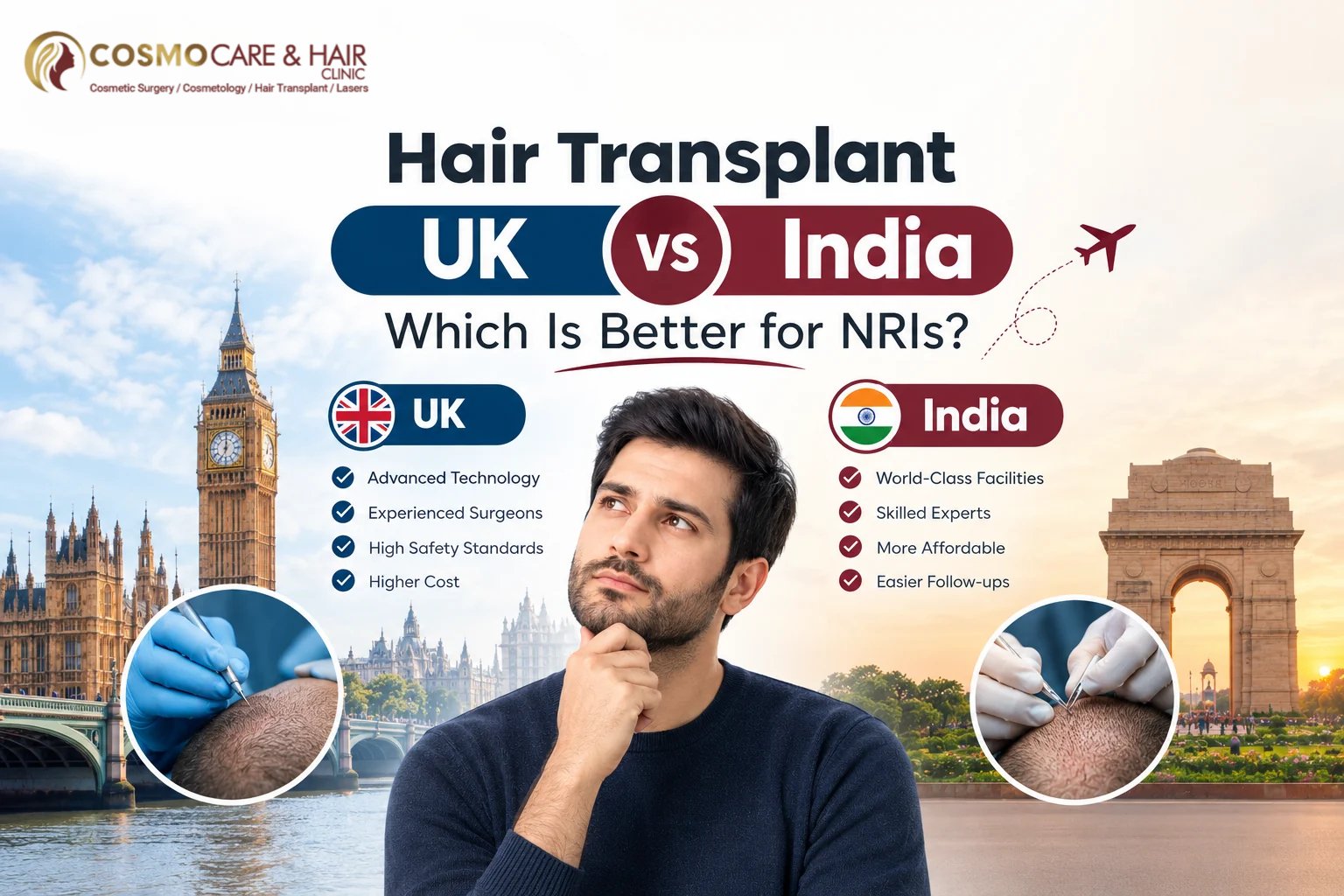
For Non-Resident Indians (NRIs) living in the United Kingdom, choosing where to undergo hair restoration involves more than comparing treatment prices. The decision around Hair Transplant UK vs India often comes down to surgeon expertise, medical standards, travel arrangements, recovery time, and access to follow-up care. While India may appeal to patients seeking more affordable treatment and the convenience of visiting family, the UK may offer easier access to local consultations and postoperative appointments.
Neither country is automatically the right choice for every patient. A clinic’s approach to diagnosis, surgical planning, donor hair management, and long-term care matters more than its location. NRIs should therefore compare individual surgeons and clinics rather than assume that a lower price or a familiar destination guarantees a better experience.
This guide explains the practical differences between hair transplants in the UK and India, helping you evaluate the options before committing to surgery.
Understanding Hair Transplant Options in the UK and India
Hair transplantation is a surgical procedure that moves hair follicles from a donor area, usually the back or sides of the scalp, to areas affected by hair loss. It is commonly considered for selected patients with permanent pattern hair loss, although suitability depends on the diagnosis, donor hair availability, and overall scalp health.
Patients in both countries may be offered two established techniques.
Follicular Unit Extraction (FUE)
FUE involves removing individual follicular units from the donor area and implanting them into the recipient area. It leaves multiple small scars rather than the single linear scar associated with strip surgery. The donor area usually needs to be trimmed or shaved, depending on the treatment plan.
Follicular Unit Transplantation (FUT)
FUT, also called the strip method, involves removing a narrow strip of scalp from the donor area. The surgeon separates the strip into individual follicular units for transplantation. This technique leaves a linear scar, which may be more noticeable with very short hairstyles.
Neither method is universally superior. The appropriate option depends on the patient’s hair characteristics, scalp condition, donor supply, hairstyle preferences, and future hair loss risk. A qualified surgeon should explain why a particular technique is suitable rather than recommend it simply because it is popular.
Hair Transplant UK vs India: Key Differences
The most useful comparison considers the complete treatment journey, including consultations, surgery, recovery, and access to medical support.
| Factor | Hair transplant in the UK | Hair transplant in India |
|---|---|---|
| Treatment cost | Can be relatively expensive | May offer lower procedure fees |
| Initial consultation | Easier for UK residents to attend locally | May begin remotely before travel |
| Travel arrangements | Usually no international travel required | Flights, accommodation, and local transport may be needed |
| Postoperative reviews | Local in-person visits may be easier | Requires planned follow-up with the clinic |
| Family support | Convenient if family lives in the UK | May suit patients with family in India |
| Clinic assessment | Verify UK surgeon and facility credentials | Verify Indian surgeon and facility credentials |
| Time away from home | Often easier to manage around local commitments | Requires coordination with travel and recovery |
| Total expenditure | Treatment and local expenses | Treatment, travel, accommodation, and follow-up expenses |
These differences vary by provider. A well-qualified surgeon in India may offer an excellent treatment experience, just as an experienced UK surgeon may provide appropriate care. Patients should evaluate documented qualifications, clinical arrangements, and aftercare rather than making assumptions based on geography.
Hair Transplant Cost in the UK vs India
Cost is a major consideration for NRIs, especially when comparing a local procedure with treatment during a visit to India.
According to the NHS, a hair transplant in the UK can cost between £1,000 and £30,000, depending on the extent of hair loss, the procedure, and the clinic and team involved. This is a broad published range, not a personalised estimate for an individual patient.
Indian clinics set their fees according to factors such as the number of grafts, surgical technique, surgeon involvement, facilities, and complexity of the case. Patients should request an individual quotation rather than rely on an advertised starting price.
What should you include in your budget?
A meaningful cost comparison should account for the complete treatment journey.
- Surgical fees: The procedure, clinical team, and services included in the quotation.
- Consultations and tests: Initial assessment, medical history review, and any necessary investigations.
- Travel and accommodation: Return flights, local transport, accommodation, and additional nights if recovery requires a longer stay.
- Time away from work: Annual leave, unpaid leave, or other financial implications.
- Postoperative care: Follow-up consultations, medication, and any additional assessments.
- Unexpected expenses: Changes to travel plans or medical care if complications occur.
For example, an NRI who already plans to visit family in India may face different travel costs from someone booking an international trip solely for surgery. However, combining treatment with a holiday should never take priority over recovery instructions or medical advice.
The better financial decision is the one that balances the complete cost with appropriate surgical care and dependable follow-up.
Why Surgeon Qualifications Matter More Than Location?
A hair transplant requires medical assessment, careful donor harvesting, recipient-site planning, and postoperative management. Poor planning can affect hairline appearance, graft survival, donor density, and the options available for future treatment.
Before selecting a clinic in either country, verify the surgeon’s qualifications and registration.
In England, patients can check a doctor’s registration with the General Medical Council and confirm whether the relevant clinic or hospital is registered with the Care Quality Commission where required. In India, patients should verify the doctor’s registration with the appropriate medical regulatory authority and ask about the facility’s applicable registration and clinical standards.
The Indian government’s published minimum standards for hair transplant centres also provide a useful reference when asking clinics about their facilities, equipment, emergency arrangements, and clinical processes.
Questions to ask before booking surgery
- Who will perform the extraction, create the recipient sites, and oversee implantation?
- What training and experience does the surgeon have in hair restoration?
- How many grafts are recommended, and what is the medical reasoning behind that number?
- How will the surgeon protect the donor area and plan for future hair loss?
- What complications may occur, and how will they be managed?
- Who will provide postoperative reviews and help if a concern develops after returning home?
Be cautious if a clinic promises guaranteed growth, pressures you to book immediately, or focuses on selling a high graft count without examining your scalp. A proper consultation should include limitations, risks, alternatives, and realistic expectations.
Recovery and Follow-Up for NRIs Returning to the UK
Recovery planning is one of the most important differences for patients travelling internationally for surgery.
The NHS notes that patients may need one to two weeks away from work after a hair transplant. Transplanted hair commonly sheds during the initial weeks before new growth develops. Early growth may appear after around four months, while the final result can take approximately 10 to 18 months.
These are general timelines. Individual recovery and growth vary.
What happens during the first few weeks?
Immediately after surgery, the scalp may feel tender or tight, and swelling, redness, and small scabs can develop. Patients must follow the surgeon’s instructions on washing, sleeping positions, physical activity, and protecting the grafts.
The first two weeks are particularly important because newly transplanted grafts need protection. Ask the surgeon when you can resume normal activities and whether your planned flight is appropriate for your recovery.
How can you arrange aftercare from the UK?
If you undergo surgery in India, confirm the postoperative arrangements before travelling. Ask how many in-person reviews are recommended, whether remote consultations are available, and who will assess you if symptoms arise after returning to Britain.
A video consultation can support communication, but it cannot replace an in-person examination when one is medically necessary. You should also identify a local healthcare provider who can assess urgent concerns.
The NHS advises patients considering treatment abroad to understand the risks, organise suitable recovery time, check insurance arrangements, and calculate the possibility of extra travel or treatment expenses.
Risks Every Hair Transplant Patient Should Understand
Hair transplantation is surgery, so choosing an attractive package or convenient destination should never replace a proper assessment of risk.
Potential complications include bleeding, infection, reactions to anaesthesia, scarring, and failure of some transplanted follicles to grow. Some patients may also experience an unnatural hairline, uneven density, or continued thinning in untreated areas.
Another important consideration is progressive hair loss. Transplanted hair does not prevent surrounding native hair from thinning. A responsible treatment plan should consider the patient’s likely future hair loss pattern and whether medical management or additional procedures may be appropriate.
Before consenting to surgery, ask for a clear explanation of the expected benefits, limitations, alternatives, and arrangements for treating complications. Check whether your travel insurance excludes planned medical treatment or complications arising from it, and do not assume that ordinary travel insurance will cover corrective surgery.
When Should an NRI Choose the UK or India?
The right destination depends on your circumstances rather than a universal ranking of the two countries.
When the UK may suit your needs?
A UK clinic may be practical if you prefer local consultations, need to minimise international travel, or want easier access to the same treating team during recovery. It can also be suitable if work or family responsibilities make an extended stay abroad difficult.
When India may suit your needs?
India may be worth considering if you have access to a suitably qualified surgeon, can arrange an adequate recovery period, and have a clear follow-up plan for when you return to the UK. It may also be convenient if you already intend to visit family in India.
In either case, compare the surgeon’s experience, proposed technique, complete costs, facility standards, and aftercare arrangements. If these details are unclear, delay booking until you have satisfactory answers.
Personalised Hair Restoration Guidance at Cosmo Care & Hair Clinic
For NRIs considering treatment in India, a detailed consultation can help establish whether hair transplantation is appropriate and what type of treatment may be suitable.
At Cosmo Care & Hair Clinic, Dr. Rahul Goyal focuses on individualised consultation, careful treatment planning, patient comfort, and natural-looking outcomes. The clinic’s approach emphasises understanding each patient’s concerns before recommending a treatment plan.
Before making travel arrangements, discuss your hair loss history, donor area, expectations, medical suitability, and postoperative requirements. Ask for a clear explanation of the proposed procedure, expected recovery, and arrangements for support after returning to the UK.
Your decision should be based on an appropriate clinical assessment and a realistic understanding of the entire treatment journey, not solely on price or promotional claims.
Conclusion: Make an Informed Hair Transplant Decision
The comparison of hair transplant treatment in the UK and India involves much more than the initial procedure fee. The UK may offer easier local access to follow-up appointments, while India may provide a practical alternative for NRIs who can travel and arrange appropriate postoperative care.
Neither destination guarantees better results. Surgeon qualifications, donor hair management, realistic treatment planning, clinical standards, and long-term follow-up should guide your choice.
Considering a hair transplant in India? Contact Cosmo Care & Hair Clinic to discuss your hair restoration concerns with Dr. Rahul Goyal, understand your treatment options, and plan your next steps with informed medical guidance.
Frequently Asked Questions
1. Is a hair transplant in India cheaper for NRIs?
Treatment fees may be lower in India, but total expenditure depends on the procedure, surgeon, travel, accommodation, time away from work, and aftercare. Request itemised quotations from both countries before comparing costs.
2. Can I return to the UK soon after a hair transplant in India?
Your return date should be planned with your treating surgeon. Consider your recovery, travel arrangements, and any recommended postoperative examination. Do not book a tight return schedule before receiving medical guidance.
3. Are hair transplant results better in the UK or India?
Results depend on individual suitability, surgeon expertise, donor hair quality, surgical planning, and postoperative care. The country alone does not determine the outcome, and no clinic can guarantee that every graft will grow successfully.
4. How long does it take to see hair transplant results?
New growth may begin to appear after approximately four months, but visible improvement develops gradually. The NHS indicates that final results can take around 10 to 18 months, although the timeline varies between patients.
5. What should NRIs check before choosing a hair transplant clinic in India?
Verify the surgeon’s qualifications and registration, the clinic’s facilities, the proposed treatment plan, total costs, possible complications, and follow-up arrangements in the UK. Obtain written aftercare instructions and clear contact details before travelling for surgery.
6. Is Hair Transplant India for NRI a good option?
Hair Transplant India for NRI can be a practical option for those seeking personalised treatment and the convenience of visiting family in India. Before booking, verify the surgeon’s qualifications, compare total treatment and travel costs, plan adequate recovery time, and confirm follow-up care after returning to your country of residence.