
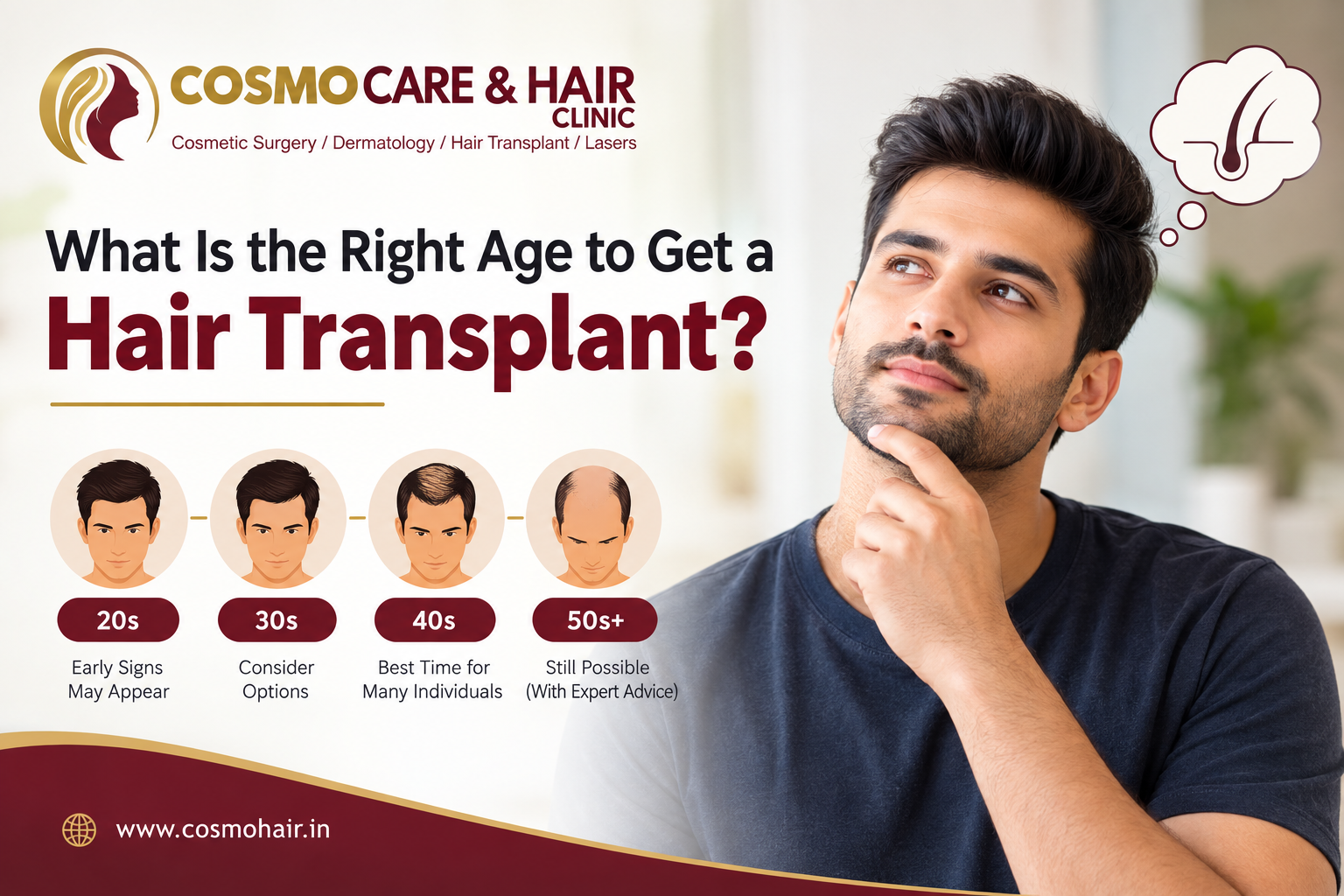
Hair loss can affect confidence at any age, but one of the most common questions people ask before considering a hair transplant is, “What is the right age to get it done?” There is no fixed age that works for everyone. The right time depends on factors such as the cause of hair loss, how stable the hair loss is, the condition of the donor area, your overall health, and how your hair may change in the future.
For many people, waiting until the hair-loss pattern becomes clearer can make treatment planning easier. However, age alone should never be the only factor when deciding whether you are ready for a hair transplant.chand
Is There a Fixed Age for Getting a Hair Transplant?
There is no universal age at which everyone should undergo a hair transplant. Every person’s hair-loss pattern is different.
In younger people, especially those in their late teens or early twenties, hair loss may still be progressing. If a transplant is performed too early, the natural hair around the transplanted area may continue to thin or recede.
This can affect the overall appearance over time and may require additional treatment in the future.
For this reason, doctors usually assess the stability and pattern of hair loss rather than simply looking at the patient’s age.
In many cases, patients in their mid-20s and above may have a clearer hair-loss pattern, making it easier to plan the hairline and use the available donor hair appropriately.
Why Waiting Can Be Important for Younger Patients?
Hair loss at a young age can be stressful. A receding hairline or thinning crown may make someone want to undergo a transplant immediately.
However, rushing into surgery is not always the best approach.
If your hair is still actively thinning, it may be difficult to predict how much natural hair you will lose over the next few years. A transplant only moves existing healthy hair follicles from one area to another. It does not stop future hair loss in untreated areas.
For example, a young patient may have a noticeable receding hairline today. After transplantation, the transplanted hair may remain while the natural hair behind it continues to thin. This can create an uneven appearance later.
A good treatment plan therefore considers both your current hair loss and possible future hair loss.
What Age Groups Should Consider Before Surgery?
Age can provide a general idea, but it should not be treated as a strict rule. Your doctor will also consider your hair-loss pattern, donor area and treatment goals.
| Age | What to Consider |
|---|---|
| Below 20 | Hair loss may still be developing, so diagnosis and non-surgical treatment are usually considered first. |
| 20–24 | A detailed assessment is important because future hair loss may still be difficult to predict. |
| 25–35 | Many patients in this age group can be considered if hair loss is suitable and donor hair is adequate. |
| 36–50 | Treatment can focus on restoring density and improving the hairline according to the existing pattern. |
| 50+ | Age alone does not rule out treatment; donor hair, health and realistic expectations are important. |
These are general considerations, not fixed medical eligibility criteria. Two people of the same age can have completely different hair-loss conditions.
Is 25 a Good Age for a Hair Transplant?
Around the age of 25, many people have a more established hair-loss pattern than they did during their teenage years or early twenties.
This can make it easier for a doctor to assess the hairline, crown, donor area and likely future progression.
However, turning 25 does not automatically mean you need or qualify for a hair transplant. Some people may experience stable hair loss earlier, while others may continue losing hair after 25. The decision should therefore be based on an individual examination rather than age alone.
If you are around 25 and experiencing significant hair loss, a consultation can help determine whether you are a suitable candidate or whether it would be better to first manage ongoing hair loss.
Can You Get a Hair Transplant in Your Early 20s?
A person in their early 20s may sometimes be considered for a hair transplant, but doctors generally approach such cases carefully.
The first step should be identifying the reason for hair loss. Male pattern hair loss is common, but hair thinning can also be related to nutritional deficiencies, hormonal changes, certain medical conditions, stress, scalp problems or other factors.
If hair loss is still progressing rapidly, the doctor may recommend monitoring the condition or considering suitable medical treatment before surgery.
For younger patients, maintaining realistic expectations is also important. The objective should not simply be to create a very low hairline. The treatment should preserve donor hair for possible future needs.
What Factors Matter More Than Your Age?
Age is only one part of the decision. Several other factors can be more important when determining whether you are ready for a hair transplant.
Stability of Your Hair Loss
A stable hair-loss pattern makes it easier to plan the treatment.
If your hairline is continuously receding or the crown is rapidly becoming thinner, immediate transplantation may not always be recommended.
Availability of Donor Hair
Hair transplant procedures depend on healthy follicles from the donor area, usually located toward the back and sides of the scalp.
The doctor needs to determine the density, quality and availability of these follicles before planning the number of grafts.
Cause of Hair Loss
Not every type of hair loss requires transplantation.
Understanding the underlying cause is an important part of the consultation. Treating the cause where possible can sometimes help control further hair loss.
Your Expectations
A hair transplant can improve coverage and restore the appearance of thinning areas, but it cannot create unlimited hair density.
A good consultation should explain what can realistically be achieved based on your existing donor hair and degree of hair loss.
Overall Health
Your general health and scalp condition also matter before undergoing any surgical procedure.
Your doctor may ask about your medical history, medications and other relevant factors before recommending treatment.
Does Hair Transplant Work for Older People?
Being older does not automatically mean that you cannot have a hair transplant.
Many people consider hair restoration in their 40s, 50s and beyond. In these cases, the focus is often on improving the hairline, adding coverage to thinning areas and achieving a natural appearance.
However, the amount of donor hair and the extent of existing hair loss become particularly important.
An older patient may have a different treatment goal from a younger patient. Instead of trying to recreate the density of teenage years, the objective may be to achieve a balanced and natural-looking improvement.
Therefore, there is no specific upper age limit that applies to everyone. A proper consultation is necessary to determine suitability.
How Is Your Hair Transplant Plan Decided?
Before recommending a procedure, a hair transplant doctor should evaluate your current condition rather than simply quote a number of grafts.
The consultation may involve examining:
- Your hairline and recession pattern
- Crown and mid-scalp thinning
- Donor-area density
- Hair shaft thickness
- Scalp condition
- Family history of hair loss
- Previous treatments
- Expected future hair loss
- Your desired appearance and expectations
This information helps the doctor decide whether a transplant is appropriate and how the procedure should be planned.
At Cosmo Care & Hair Clinic, the focus is on understanding the patient’s concerns first and then discussing a treatment approach according to individual requirements and goals.
When Should You Consider a Hair Transplant?
You may consider consulting a hair transplant specialist if you have:
- A visibly receding hairline
- Significant thinning on the scalp
- A thinning or bald crown
- Pattern hair loss that has become more stable
- Sufficient donor hair
- Realistic expectations about the result
- A desire for a long-term hair-restoration plan
However, having one or more of these concerns does not automatically mean surgery is required.
A specialist may recommend a hair transplant, medical treatment, observation, or a combination of approaches depending on your condition.
How to Choose the Best Hair Transplant Doctor?
Choosing the best hair transplant doctor should not be based only on advertisements, discounted packages, or before-and-after photographs.
Patients should look at the doctor’s qualifications, experience, approach to diagnosis, treatment planning, and follow-up care. It is also important to understand who will evaluate your condition, design the treatment, and perform the important surgical stages. During your consultation, ask questions about the expected result, donor hair, future hair loss, recovery, and possible need for additional procedures.
This can help you make an informed decision rather than choosing a treatment simply because it is being promoted as the best hair transplant option.
Why Professional Consultation Matters Before Surgery
The right age for a hair transplant cannot be decided accurately through an online age calculator or by comparing your hair with someone else’s.
A person who is 23 may have a very different hair-loss pattern from someone who is 30. Similarly, a 45-year-old with good donor hair may be a suitable candidate even when someone younger is advised to wait.
That is why a personalised assessment is important.
At Cosmo Care & Hair Clinic, Dr. Rahul Goyal focuses on understanding the concerns and expectations of patients before suggesting a suitable treatment approach. The clinic aims to provide personalised care throughout consultation, treatment and follow-up.
So, What Is the Right Age for a Hair Transplant?
The right age for a hair transplant is not determined by a single number.
For younger patients, especially those whose hair loss is still progressing, waiting may allow the pattern to become clearer and help with long-term planning. For patients in their mid-20s and beyond, transplantation may be considered when the hair-loss pattern, donor supply, health and expectations are suitable.
Even patients above 40 or 50 may be candidates if they have adequate donor hair and realistic treatment goals.
The most important question is therefore not “Am I old enough for a hair transplant?” but “Is my hair loss suitable and stable enough for a well-planned transplant?”
A professional consultation can help answer that question based on your individual condition.
Frequently Asked Questions About Hair Transplant Age
1. What is the ideal age for a hair transplant?
There is no ideal age that applies to everyone. Many patients are evaluated for transplantation once their hair-loss pattern is sufficiently established, often from the mid-20s onward. The decision depends on hair-loss stability, donor hair and individual treatment goals.
2. Can I get a hair transplant at 21 or 22?
It may be possible in selected cases, but younger patients require careful assessment because hair loss may continue to progress. A doctor may recommend waiting or managing the hair loss first if the pattern is not stable.
3. Is 25 too late for a hair transplant?
No. At 25, a person can still be a suitable candidate for hair restoration. What matters is the condition and progression of hair loss, donor hair availability and overall suitability for the procedure.
4. Can someone over 50 get a hair transplant?
Yes. There is no universal upper age limit. Older patients can be considered when they have adequate donor hair, suitable health and realistic expectations about the achievable result.
5. Should I wait if I am still losing hair?
If hair loss is progressing rapidly, your doctor may recommend managing or monitoring it before transplantation. This can help create a more appropriate long-term treatment plan and avoid using donor grafts unnecessarily.
Take the Right Step for Your Hair Restoration
If you are confused about whether you are too young, too old or simply not sure whether a hair transplant is right for you, don’t make the decision based on age alone.
A detailed consultation can help identify the cause and stage of your hair loss, assess your donor area and explain the treatment options available for your condition.
For personalised guidance about hair restoration and FUE hair transplant, connect with Cosmo Care & Hair Clinic and discuss your concerns with an experienced specialist.
Book your consultation today and take the first step towards a personalised hair-restoration plan designed around your hair, appearance and long-term goals.